Methods

HealthyPlan.City combines built environment datasets from different sources with demographic data from the Canadian Census to present a picture of environmental equity in urban areas for 129 cities across Canada. The data used in this tool covers municipalities in Canada with a population of over 30,000 individuals. Urban boundaries are established by Statistics Canada and are based on Census Subdivisions, which provide the administrative boundaries of all municipalities across Canada. Data is mapped for areas with a population density of 400 people per square kilometer or more. The geographic area covered by the HealthyPlan.City tool is home to 24,618,003 people. A full list of communities included in this tool is provided at the end of this page.
Demographic Data
Demographic data for vulnerable populations included in HealthyPlan.City come from the 2021 Census of Canada and were obtained for dissemination areas. A dissemination area is a small area composed of one or more neighbouring dissemination blocks. Dissemination blocks are bounded on all sides by roads and/or natural or manmade boundaries. Dissemination blocks typically represent a street block in urban areas, but can be larger in suburban areas. Dissemination blocks are the smallest areas for which population counts are reported in Canada.
We downscaled the dissemination area data by assigning the percentage of each vulnerable population group to all the dissemination blocks within each dissemination area. The dissemination block data come with total population, which allows us to calculate the absolute number and percentage of people in each vulnerable population group that live in each dissemination block.
The following vulnerable populations are included in the HealthyPlan.City tool:
- Low-income individuals: Percentage of population (all ages) under the after-tax low-income threshold.
- Children: Percentage of population under 15 years of age.
- Older adults: Percentage of population over 64 years of age.
- Visible minority individuals: Percentage of population that identify as a visible minority.
- Individuals living alone: Percentage of population in private households who live alone.
- Newly-arrived immigrants: Percentage of population who are immigrants to Canada between 2011 and 2021.
- First-generation immigrants: Percentage of population who are immigrants born outside of Canada.
- Low-income children: Percentage of children (under 18 y/o) under the after-tax low-income threshold.
- Low-income older adults: Percentage of older adults (over 64 y/o) under the after-tax low-income threshold.
- Low-income visible minority individuals: Percentage of population under the after-tax low-income cut-off threshold that identify as a visible minority.
- Low-income individuals living alone: Percentage of population under the after-tax low-income cut-off threshold that live alone.
- Low-income newly-arrived immigrants: Percentage of population under the after-tax low-income cut-off threshold who are immigrants to Canada between 2011 and 2021.
- Low-income first-generation immigrants: Percentage of population under the after-tax low-income cut-off threshold who are immigrants born outside of Canada.
Built Environment Data

Built environment data included in HealthyPlan.City are derived from a number of sources including satellite imagery, Open Street Map, and other geospatial databases. These datasets are presented under four data themes:
- Urban Climate
- Community Amenities
- Parks and Recreation
- Air and Noise pollution
The Urban Climate data theme includes three data layers:
- Average summer temperature is the average land surface temperature from May to September 2019-2021 derived from LandSat 8 satellite data in Google Earth Engine. This data was obtained using an adapted code shared on StackExchange by Edwin Osei (April 22, 2020). The average of values within each dissemination block is reported.
- Tree canopy cover is the average percentage of tree canopy cover within the dissemination block. Tree Canopy Cover data comes from Google, Meta and the World Resource Institute. Google data was available for all but 15 municipalities. High-resolution imagery was analyzed with a semantic segmentation model using polygons of trees performed by annotators. The model was aggregated to 30 m resolution and then averaged across the dissemination block. The remaining 15 municipalities were retrieved from Meta & World Resources Institute via Google Earth Engine. The proportion of cells indicating tree height 3 m or higher were aggregated to 30 m resolution and then averaged across the dissemination block.
- Flood susceptibility indicate areas that are prone to flooding. This data layer comes from Natural Resources Canada's Flood Susceptibility Index, which used machine learning algorithms to predict how likely areas are to flood based on patterns of major Canadian flood events since the 1970s. The dataset is produced at a 30 m spatial resolution. Only areas within 30 m of buildings were used to assess flood susceptibility. The average flood susceptibility across all buildings is reported. Values close to 0 indicate low susceptibility to flooding and values close to 100 show areas that are the most susceptible to flooding. Building footprints were retrieved from Microsoft Bing Maps V1.1 (2019). Statistics Canada Open Database of Buildings V2.0 (2019) was used for dissemination blocks that had buildings where Microsoft Bing Maps did not.
The Community Amenities data theme includes four data layers:
- Transit stops is the number of public transit stop locations within a 500 m walking distance. The average number of transit stops within a 500 m street network distance of all buildings within the dissemination block is reported. Transit stop amenities were extracted from the Statistics Canada Open Database of Infrastructure (Version 1.0). Statistics Canada assembled this database using General Transit Feed Specification (GTFS) data from public transit agencies across Canada. Walking routes were determined using transportation data from OpenStreetMap. Building footprints were retrieved from Microsoft Bing Maps January 2023.
- Educational facilities is the number of facilities such as early childhood educational centres, schools, vocational training centres and post-secondary institutions within a 1 km walk. The average number of educational facilities within a 1 km street network distance of all buildings within the dissemination block is reported. Educational facilities were extracted from the Statistics Canada Open Database of Educational Facilities (Version 2.1). Statistics Canada assembled this data from municipal and provincial governments’ open data portals and web pages. Walking routes were determined using transportation data from OpenStreetMap. Building footprints were retrieved from Microsoft Bing Maps in January 2023.
- Retail and services is the number of retail and services outlets such as stores, restaurants, malls, professional services, pharmacies and banks within a 1 km walk. The average number of retail and service outlets within a 1 km street network distance of all buildings within the dissemination block is reported. Retail and service amenities were extracted from the OpenStreetMap database in November 2022. Walking routes were determined using transportation data from OpenStreetMap. Building footprints were retrieved from Microsoft Bing Maps in January 2023.
- Healthy food outlets is the number of fresh food outlets such as supermarkets, groceries, delis, butchers, markets, fishmongers and bakeries within a 1 km walk. The average number of healthy food outlets within a 1 km street network distance of all buildings within the dissemination block is reported. Healthy food outlet amenities were extracted from the OpenStreetMap database in November 2022. Walking routes were determined using transportation data from OpenStreetMap. Building footprints were retrieved from Microsoft Bing Maps in January 2023.
The Parks and Recreation data theme includes three data layers:
- Large natural areas is the number of forests, beaches, wetlands, grass and nature reserves within a 1 km radius. Large natural areas were extracted from the OpenStreetMap database in November 2022.
- Parks is the number of community gardens, neighbourhood parks and large parks within a 1 km radius. Parks were extracted from the OpenStreetMap database in November 2022.
- Recreation and sports facilities is the number of recreational and sports facilities such as arenas, swimming pools, gyms, aquariums, bowling alleys, fitness centers and bingo halls within a 1 km radius. Recreational and sports facilities were extracted from the OpenStreetMap database in November 2022.
- Greenspace provision is the available greenspace (in m2) per person within a 500 m walk. Greenspaces are composed of parks, open spaces, large natural areas, outdoor recreation spaces, forests, and other similar land uses. The number of people within 500 m of a greenspace was determined using the Statistics Canada Geographic Attribute File at the dissemination block level and transportation data from OpenStreetMap. Components of greenpace provision were extracted from the OpenStreetMap database in November 2022.
The Air and Noise Pollution data theme includes two data layers:
- Air pollution is a modeled estimate of nitrogen dioxide air pollution (a marker of traffic-related air pollution) for the year 2016 developed by Hystad et al.
- Noise pollution is calculated as the number of noise points such as airports, runways, helipads, railroads, fire and ambulance stations and major roads within a 1km radius. Noise pollution features are extracted from the OpenStreetMap database in November 2022.
Equity Priority
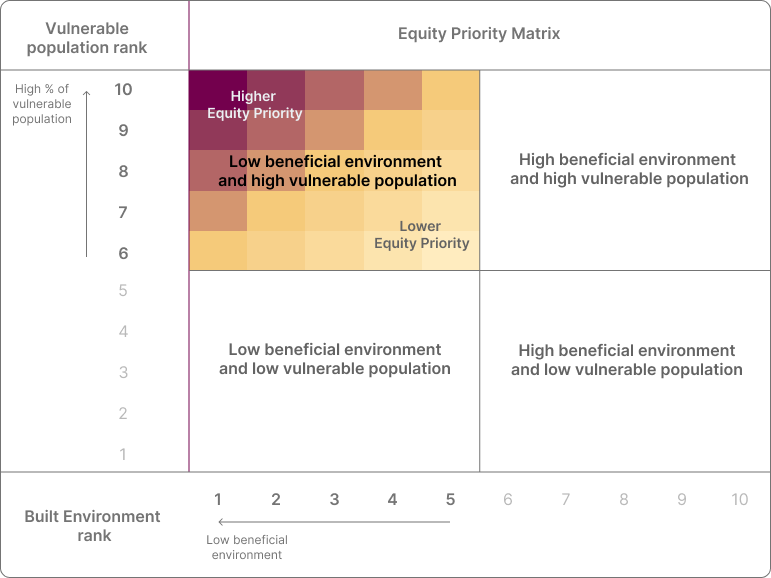
To identify locations where environmental inequity exists, the percentages of vulnerable populations and the values for the built environment indicators for all dissemination blocks within a city were ranked from 1 to 10, with 1 being the lowest 10% of the values (i.e. low percentage of vulnerable population group or the lowest levels of beneficial environment), and 10 being the highest 10% of the values (i.e. highest percentage of vulnerable population group or the highest levels of beneficial environment).
Equity Priority is identified by combining the vulnerable population ranks > 5 (higher percentages of vulnerable populations) and the built environment ranks < 6 (lower levels of beneficial environments), as shown in the Equity Priority matrix below. In these locations, vulnerable demographic groups make up a greater proportion of the population, but experience fewer benefits or more risk from the built environment relative to the city-wide median. Darker shades of red are used to show higher equity priorities.
Equity by the numbers
The Equity by the Numbers window provides additional information on environmental inequity in Canadian cities.
This window shows the percentage and number of vulnerable population individuals in the selected city that live in less beneficial built environment areas. This is obtained by dividing the number of vulnerable population individuals that live in less beneficial built environment areas (ranked < 6 for a built environment indicator; see “Equity Priority” section above) by the total number of vulnerable population individuals in the entire city.
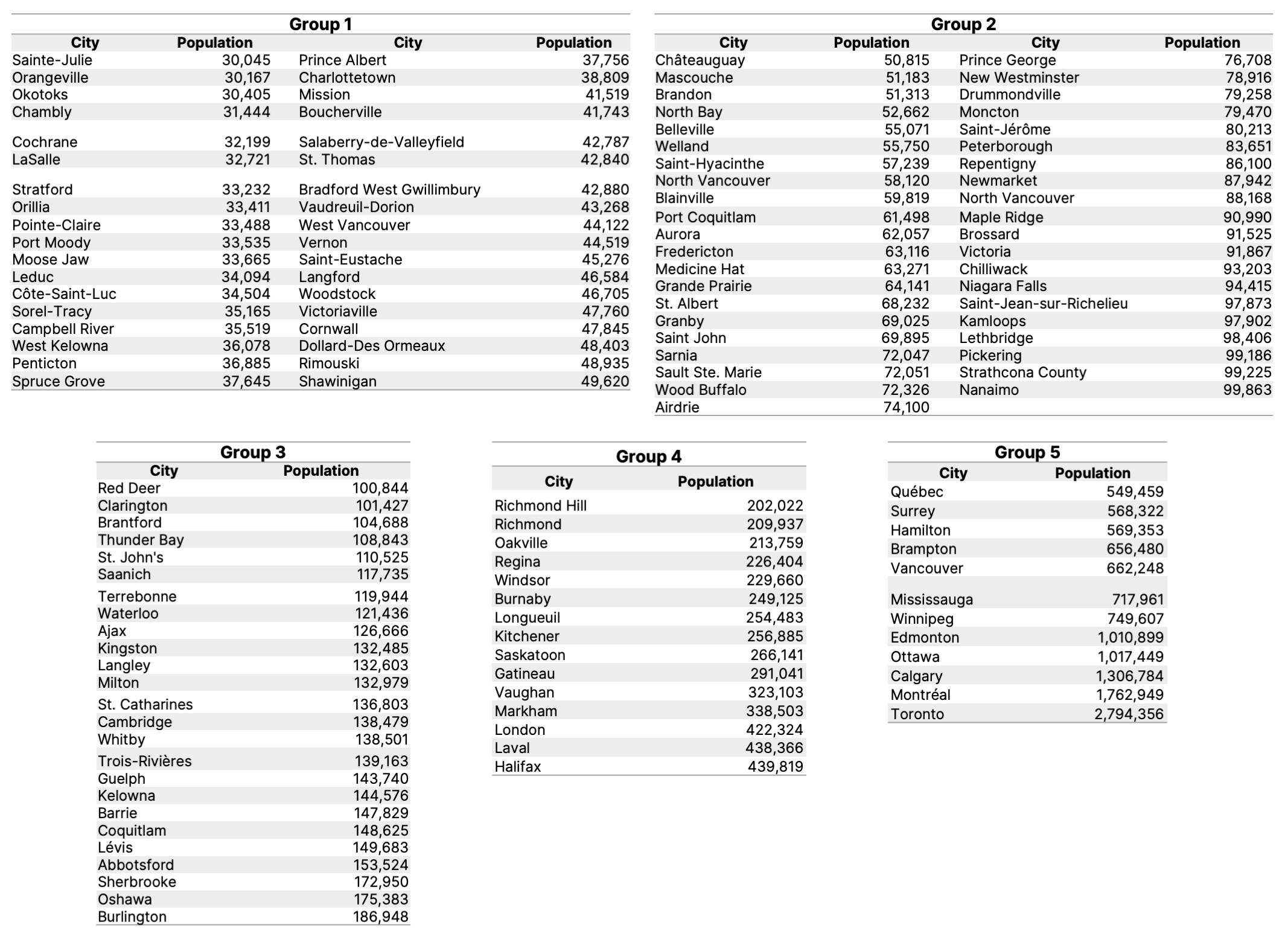
This window also ranks the selected city amongst similar-sized cities in terms of equitable distribution of built environment indicators. The most equitable cities are those with the lowest percentage of vulnerable populations living in less beneficial environment areas. To compare similar-sized cities, all cities included in HealthyPlan.City are divided into five groups based on population size: Group 1 are cities with populations of 30,000 to 50,000 individuals; Group 2 are cities with populations of 50,000 to 100,000 individuals; Group 3 are cities with populations of 100,000 to 200,000 individuals; Group 4 are cities with populations of 200,000 to 500,000 individuals; and Group 5 are cities with populations of over 500,000 individuals. Cities within each of these groups are ranked against each other in the histogram. A list of cities in each group is included at the end of this page.
Distribution
The Distribution window plots the built environment and vulnerable population indicators for each dissemination block in a city. Each dot in the scatter plot represents a dissemination block and shows its built environment and proportion of vulnerable population values on the vertical and horizontal axes, respectively. When a user clicks on a location on the map, a point on the scatter plot representing this location is highlighted.
Neighbourhoods
Toggling the Neighbourhoods function On outlines boundaries for neighbourhoods within cities. Neighbourhood boundaries are obtained from open data portals or from municipal staff and are available for some but not all cities included in the HealthyPlan.City tool. The boundaries defining neighbourhoods are based on publicly available data and are therefore not standardized; they include urban planning districts used for official community plans, electoral wards, and locally-defined neighbourhoods.
The Equity by the Numbers and Distribution functions are adapted when the Neighbourhood option is selected. For Equity by the numbers, the city-wide proportion of vulnerable population individuals in low beneficial built environments that live in a given neighbourhood is shown. This is calculated by dividing the number of vulnerable population individuals in low beneficial environments (individuals living in areas where vulnerable population ranks > 5 and built environment ranks <6; see Equity priority section) within a neighbourhood zone by the total number of vulnerable population individuals in low beneficial environments in a city. Neighbourhoods within a selected city are ranked against each other. For Distribution, the values of built environment indicators and the proportion of vulnerable population individuals are aggregated for all dissemination blocks within each neighbourhood zone. Each dot in the scatter plot represents a neighbourhood zone, allowing easy comparison across neighbourhoods in a given city.
Note that some neighbourhood zones are only partially covered by the urban boundary of a given city. In these cases, only dissemination blocks falling within the neighbourhood zones are considered in the calculations mentioned above.
List of Canadian cities included in HealthyPlan.City
Overview
The CHERI infographic combines multiple dimensions of urban environment that influence health risks related to extreme weather and climate with sociodemographic indicators of population vulnerability.
The CHERI is based on the following assumption:
Cities are only as resilient to climate change and extreme weather as their vulnerable populations are.
Climate and extreme weather risk is not spread evenly across Canadian cities due to small scale variations in how high the maximum temperature can reach due to small scale ‘heat islands’ and variations in where flood risk is greatest. When greater heat and flood risks intersect with greater population vulnerability, the level of resilience is less. Tree canopy cover brings a cooling effect, and natural spaces and parks can absorb heavy rainfall, reducing flood risk. When these protective built environment factors are distributed inequitably, resilience is poorer.
Infographic Overview
The CHERI is a radial plot based on four climate-relevant urban environment factors using data from HealthyPlan.City:
- Average Summer Temperature
- Tree Canopy Cover
- Flood Susceptibility
- Large Natural Spaces & Parks
In creating CHERI, it is assumed that Land Surface Temperature and Tree Canopy Cover are relevant to heat exposure, collectively representing an adverse and beneficial (shading/cooling) urban environmental factor, respectively. Similarly, combining Flood Susceptibility and Large Natural Spaces & Parks (reducing precipitation accumulation - a so-called ‘sponge effect’), best represents flood exposure risk. Those four factors are thus used to calculate three combined scores:
- Heat | Land Surface Temperature and Tree Canopy Cover
- Flood | Flood Susceptibility + Large Natural Spaces & Parks
- Combined | All four factors combined
The Heat Score is shown in the box on the left, the Flood Score is shown in the box on the right, and the CHERI is shown in the centre. Larger scores suggest less inequity in climate risks, contributing to a more resilient city.
Population and individual vulnerability to climate risk is dependent upon many factors and actual data to determine vulnerability is lacking. Therefore, falling below Statistics Canada’s low income threshold is assumed to represent a proxy for potential vulnerability when combined with an additional individual characteristic based upon age, race, or immigrant status.
Each wedge on the radial plot is represented by one of four vulnerable populations. There is one wedge for each vulnerable population and climate-relevant factor combination. The four vulnerable groups are:
- Children in low-income households
- Low-income older adults
- Low-income visible minorities
- Low-income newly arrived immigrants
Individual and Combined Scores
Individual scores refer to a specific wedge on the radial plot. Each individual score refers to a specific built environment and vulnerable population combination. Combined scores refer to the aforementioned Heat, Flood, and CHERI scores, and these can be either a Basic Score or an Expanded Score. By default the Basic Score is shown, which considers only children in low-income households and low-income older adults. Clicking the ‘Expand Vulnerable Group’ button will show the Expanded Score, which adds low-income visible minorities and low-income newly arrived immigrants to the plot and considers all four vulnerable populations in the combined scores.
The less full the radial plot is filled-in by the colour wedges, the lower the CHERI score. Hovering over a wedge identifies the vulnerable population and its independent score for the corresponding built environment factor. All results are relative among similar sized cities. Wedges that are shorter than the interior, dotted black circle indicate poorer than median resilience.
Smoke wedges are not accounted for in the CHERI score (Basic or Expanded). Smoke scores are discussed further below.
Switching to Multiple City Mode enables side-by-side comparison of cities. Direct comparisons should focus on cities within the same groups (identified in the table above). Furthermore, as scores are always provided, but are calculated using the data available, comparing cities when the level of data completeness is not the same should be done with caution (i.e., comparisons may not be ‘apples to apples’). Hovering your cursor over a wedge provides information on data availability and interpretation for individual scores.
CHERI Score Calculations
CHERI scores are based on HealthyPlan.City data, namely built environment factors and vulnerable population data measured at the 2021 dissemination block level. For each wedge on the infographic, individual scores are calculated for each city according to the following metrics:
- ya = The mean built environment value in the more vulnerable half of the population
- yb = The mean built environment value for the less vulnerable half of the population
- cm = The mean built environment value for the city
- wm = The mean built environment value across all cities of the similar size
From the above, two intermediate metrics are derived (discussed further below):
- ya / yb - measures within city inequity in exposure
- cm / wm - measures between city differences in exposure
These two metrics are then multiplied:
- Individual scores = (ya / yb) * (cm / wm)
All individual scores are directionally-aligned (i.e. inverted where necessary) to ensure higher numbers indicate better resilience. Namely, higher values for both Flood Susceptibility and Land Surface Temperature variables indicate higher risk, and therefore the individual scores are inverted so that higher numbers indicate lower risk.
As between-city differences in the exposure are captured directly by the score calculation, the scores are subsequently classified across all cities by quantile (20 classes), with values ranging from 0.5 to 10.0. All independent scores are centred around their median, which is hard coded to 5.0. All scores are rounded to the nearest 0.5. Outliers are clipped by the 1st and 99th percentile.
Some independent scores may be given a null value. Any independent score with a null value is omitted from quantile classification, and this variables participation in combined scores is omitted (and a combined score is still given for non-null scores). This occurs in situations where the vulnerable population is not present in a city; for instance, many smaller cities do not have low-income visible minorities.
Each of the three combined scores are calculated by averaging each valid individual score (i.e. any score without a null value). Note that the non-quantile classification score ((ya / yb) * (cm / wm)) is averaged, not the quantiles themselves.
As an example for the Basic Heat Score, the following individual scores are averaged: tree canopy cover and low-income children, tree canopy cover and low-income older adults, average summer temperature and low-income children, average summer temperature and low-income older adults. The steps for quantile classification, centering on the median, rounding to 0.5, and clipping the 1st and 99th percentiles are then executed in the same way as above.
CHERI Score Calculations
The metric ya / yb identifies inequity within the city; on average, the built environment poses a higher risk to the vulnerable population than the non-vulnerable population. Thus, if the value is less than 1.0, an inequity exists. Values greater than 1.0 are truncated to 1.0 so as not to yield favourable scores to cities where the built environment risk is greater in the non-vulnerable population than the vulnerable population. For instance, if ya / yb yields 1.2, the value is truncated to 1.0.
The metric cm / wm identifies how the urban environment factor relates to cities of a similar size. Values less than 1.0 indicate the urban environment factor for this city is less than favourable, when compared to cities of a similar size, and values greater than 1.0 indicate the urban environment factor for this city is more favourable compared to cities of similar size.
To aid users in understanding individual scores, each wedge includes an ‘Interpretation’ line item. The interpretation is based on a categorization of both ya / yb and cm / wm to help guide users as they assess the climate risk in their city. The possible interpretations and justification for every individual score are as follows:
No inequity for this vulnerable population in this city, low risk compared to similar-sized cities
- ya / yb >= 1.0
- cm / wm >= 1.0
No inequity for this vulnerable population in this city, high risk compared to similar-sized cities
- ya / yb >= 1.0
- cm / wm < 1.0
Inequity for this vulnerable population in this city, low risk compared to similar-sized cities
- ya / yb < 1.0
- cm / wm >= 1.0
Inequity for this vulnerable population in this city, high risk compared to similar-sized cities
- ya / yb < 1.0
- cm / wm < 1.0
No score has been calculated due to insufficient data
- Insufficient data is driven by no vulnerable population in the given city.
Wildfire Smoke
Wildfire smoke is another climate change related risk cities are facing. Wildfire Smoke wedges reflect data available from CANUE: the Canadian Optimized Statistical Smoke Exposure Model (CanOSSEM) [1] and Fire Weather Index (FWI) from Environment and Climate Change Canada Climate Model scenario output relevant to wildfires [2]).
The city level estimates of the FWI were generated using data from the Canadian Forest Fire Weather Index. The absolute change in FWI for each city was downloaded as raster and extracted for each city. The “absolute change in FWI” is referred to as the FWI under climate scenario RCP2.6 by 2013-2060 when compared to 1971-2000.
The city level estimates of historical smoke pollution were derived by examining daily PM2.5 concentrations from the CanOSSEM PM2.5 smoke model. We calculated the sum of daily CanOSSEM PM2.5 concentrations for 2010-2022 only when a wildfire smoke plume was present using data from the NASA Hazard Mapping System Fire and Smoke Product [3]. We then scaled the data to the daily level for the wildfire prone season.
For an all-in-one glance at a given city’s key climate risks users can turn on the Smoke option. Clicking the ‘Show Smoke’ button also displays two additional wedges as well as a Smoke Score. The left wedge shows the predicted change in the local Fire Weather Index for 2031-2060 vs. the present (based on the % degree increase from global temperature scenario RCP2.6). While the FWI over and upwind of a city is relevant for current and future smoke exposure risk, here the FWI for the area over this selected city is displayed. The right wedge shows historical smoke pollution over the past 13 years (mean smoke season daily PM2.5 for 2010-2022). For the Smoke Score, higher numbers (larger wedges) indicate greater risk. The score on the bottom is a linear combination of these two values; recent historical PM2.5 scaled up by the % change in the FWI, again expressed in deciles among all cities.
Note: CHERI does not include the smoke score as there is assumed to be limited intraurban variability in wildfire smoke as it moves across cities located downwind.
References
- 1. Paul, N., Yao, J., McLean, K.E., Stieb, D.M., & Henderson, S.B. (2022). The Canadian optimized statistical smoke exposure model (CanOSSEM): A machine learning approach to estimate national daily fine particulate matter (PM₂.₅) exposure. Science of the Total Environment, 850, Article 157956. https://doi.org/10.1016/j.scitotenv.2022.157956
- 2. ClimateData.ca. (n.d.). Fire Weather Projections. ClimateData.ca. Retrieved [2026], from https://climatedata.ca/app/fire-weather-projections/
- 3. National Oceanic and Atmospheric Administration (NOAA), Office of Satellite and Product Operations (OSPO). (n.d.). Hazard Mapping System (HMS) – Fire & smoke products and information. Retrieved [date you accessed the page], from https://www.ospo.noaa.gov/products/land/hms.html#about